Women faced many challenges in the 1950s. True, there was the comfort and stability that comes from peace, a booming economy, a happy marriage and a house full of children. Yet, there were so many contradictory messages. Happiness was supposed to come from being a homemaker – a wife, a mother, yet being a “career girl” was gaining popularity. To attract a husband, and keep him, you were supposed to be attractive and sexy, but wholesome and proper. Sure, Marilyn Monroe had all the men swooning, but you weren’t supposed to be overtly sexual like her! It was a conservative time, after all, but traditional values were being challenged across all areas of life. The women of the 1950s smartly adapted and let their intuition guide them. They nurtured their children, supported their husbands, and managed their households with the efficiency of a CEO. And they took great delight in dressing like a woman!
Looking Like a Princess
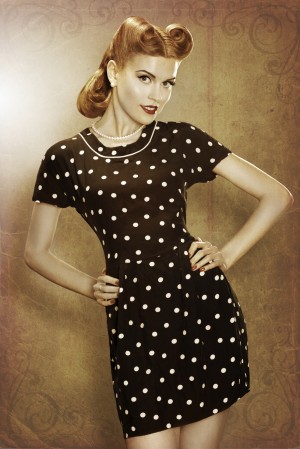 The era of femininity, introduced in the late ‘40s, continued its reign. The hour-glass silhouette, with soft rounded shoulders, nipped-in waist and voluminous skirts, made every woman feel like a princess. Women had to adjust to the longer lengths — one silver lining of the war was those short skirts — but walking and dancing in these luscious dresses made women happy to be women. Beautiful shoes returned with the highest of heels – stilettos so tall and thin they would leave marks on lobby floors. Women dressed for day – short gloves, hat and pearls — if they matched, even better! The look was pristine and immaculate. Casual wear — narrow, ankle-length pants and pedal pushers, as well as blue jeans — began taking up more space in women’s wardrobes. Although new fabrics made clothes easier to care for, dressing required substantial effort — squeezing in to constricting girdles and brassieres was not easy! By the mid-1950s, shapeless shift dresses gained popularity, as well as slim skirts worn with sweater sets. Women wore their hair short, with perfectly soft waves — thanks to regular visits to the hairdresser.
Don’t Be an Easy Number!
It seemed like everyone was getting married and rushing to start a family. The marrying age got so low, it was not unusual to marry right out of high school. If one was going to date the recommended “25-50 eligible partners” before settling on “the one,” there wasn’t a moment to waste! Dating began in earnest at age 12! Tweens were “going steady.” The term, of course, took on a new meaning, and was more like pretend marriage.  They were exclusive relationships, with a declaration of love — a class ring, a varsity jacket — but only lasted a few days, or at most a few months. Dating honored traditional roles with the boys doing the asking, paying, and expecting some affection in return. Necking and petting were accepted and common place, but pre-marital sex was forbidden — or at least the elders tried to make it so. Instructional films admonished girls to not be an “easy number.” Despite society’s efforts to make virginity sacred, teen pregnancies increased and adoptions went up 80%! Morality was losing its power!
By contrast, sex in marriage was considered vital to a healthy union, which meant young wives potentially faced decades of child bearing. Effective birth control was essential! Diaphragms were the most popular form, but women awaited The Pill, which was developed during the 1950s, but wouldn’t become available until 1960. Alfred Kinsey, with his book on female sexuality published in 1953, confronted traditional views. His findings were shocking — differences in sexuality between men and women were shaped by social and cultural forces, not biology! Sexuality — a previously taboo subject — was now being discussed and debated. Adding fuel to the fire was the launch of Playboy Magazine in 1953 with Marilyn Monroe posing nude — it was tame by today’s standards, but still shocked! The seeds of the sexual revolution of the 1960s were planted and made everyone squirm!
How To Be a Good Wife
 The role of women could be summed up by the existence of laws requiring them to take their husband’s name — no choice, no hyphenates! Their mission was to be a good wife. As the breadwinner, husbands returned home in the evening “work-weary.” A wife’s job was to brighten his day. Have dinner ready. Freshen up her makeup. Speak in a pleasant voice. And last, but not least — “stay slim and beautiful.” The role of wife, mother and homemaker was believed to be the most natural and fulfilling career for all women. Yet something was amiss. Tranquilizers became available in the mid 1950s, and within five years, 1.15 million pounds were sold, consumed mostly by women. In 1956, McCalls had the highest single issue sale ever with the feature article, “The Mother Who Ran Away.” The best-selling book Peyton Place, which would become a popular movie and TV series, touched a nerve with its sordid tale of life in a tranquil town wrought with lies, incest, infidelity and dysfunction. And Playboy illustrated the ambivalence (and their contempt — perhaps) of traditional female roles with a faux ad for the “perfect easy, low-stress, high-paying, part-time job” — that of a homemaker. There seemed to be no winning for women!
How Committed Are You To Being a Career Girl?
 Employment of women increased steadily and reached a new peak in the 1950s. Even married women worked, especially after their kids were out of the house. By 1959, 36% of women worked. Most still occupied traditional female jobs — the First National Secretaries Week was in 1952. Men suspected that the unmarried “career girls” were really just biding their time until their Prince Charming came along. With women being systematically excluded from areas like law, medicine and business, most college-bound coeds focused on “M.R.S.” degrees, which gave them four years to find a husband. Society gave them every reason to believe that their best opportunities rested with the promising career of their future husband.
‘Honey, Is That Vacuum for Me?’
You shouldn’t have — really! But suburban housewives needed every convenience. Advertisers portrayed them as too busy to cook (true or a masterful way to create need?). Food products were designed and marketed to make the homemakers’ life easier. Canned food, Minute Rice, Pillsbury cookie dough, frozen TV dinners in aluminum trays shaped like a TV — in case you didn’t understand when and where to eat them. All these quick foods were to be served in the most attractive way possible. Fancy, automatic-defrost refrigerators, electric toasters and can openers also eased the burden. The suburbs gave rise to big shopping malls with discount stores — just like the ones we have today! The first widely accepted credit card — a Diner’s Club card was created in 1958, making it even easier to buy, buy, buy!
Rebel WITH a Cause
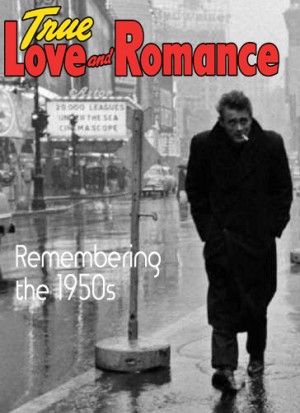 This was the first time there was a teen culture. The term “teenager” didn’t even exist until the 1950s. Initially, ignored by adults, teens yearned for their own music, style of dress – their own culture in effect. By the mid 1950s, they had become a force to be reckoned with. Adults reacted with condemnation and rules! But as rock ‘n’ roll emerged and the beat generation gained momentum, adults’ worst fears were realized. The tame sounds of the big bands were replaced with “devil’s music.” White teens began to embrace black musicians, like Chuck Berry and Little Richard, and the sexually tinged lyrics and gyrations of Elvis Presley. Portable record players and transistor radios allowed teens the independence to listen to whatever they wanted. Sorry Mom and Dad, there would be no turning back! James Dean, star of Rebel Without a Cause, was an icon of teen ennui and set the fashion trend with jeans and leather jackets. The Beats, aka beatniks as they were coined in 1958, rebelled against uniformity and traditional values. They began to congregate in the bohemian communities of New York and San Francisco. Their clothing — sunglasses, berets, and black turtlenecks — communicated their loathing of convention. Very early Goth!
We’re Going to Disneyland!
 Television became the most powerful medium, selling everything from soap to presidents. TV ad revenues soared from $12 million in 1949 to one billion dollars in 1955! Programming was aimed at families and promoted traditional values — Father Knows Best, The Adventures of Ozzie & Harriet. Viewers compared their own families against these idealized ones and tried to measure up — bad idea! The popularity of television was seen as the demise of film byHollywood. They did whatever they could to lure movie goers back to the theaters — big science fiction movies, drive-in theaters and risqué comedies that made fun of adulterous fantasies. With cars and planes, one could go anywhere. With air travel to Paris, Rome, Miami ,Hawaii, the jet set era was born. The launch of Boeing’s 707 in 1958 made planes the preferred method of long-distance travel, surpassing both trains and ocean liners. Resorts and amusement parks –Disneyland opened in 1955 — met the needs of vacationing families.
We Can’t Let the Godless Communists Win
The threat of communism dominated American life. We would ride an economic boom throughout the decade with low unemployment and great prosperity, but the Cold War, the fight between democracy and communism, haunted us. Our involvement in the Korean War was relatively brief, but reminded us that even our exceptional military power was limited. After the fighting ceased, Koreawas divided exactly as it was before the conflict. The Arms Race escalated with our testing of the hydrogen bomb in 1952. Americans had to accept that they now lived in a nuclear world, and there was no antidote for the anxiety it provoked. When the Soviets launched the first satellite into space in 1957, Americans felt inferior, and fearful that their children were not keeping up in math and science. Sound familiar? What if the communists would win, take over the world and destroy our way of life? We had to be strong. Our faith and our families were the best defense.
Conclusion
The seemingly placid fifties were a maelstrom of change. The fight for racial equality, the challenge to gender roles and sexuality were gaining momentum and would reach a tipping point in the next decade. The women of the 1950s recognized that the foundation upon which they built their lives was evolving. They had to adapt. Most accepted their traditional roles and the choices they made, but knew life would be different for their daughters. They hoped the next generation would find the balance between motherhood and professional fulfillment that had eluded them. And the beat goes on!





 A country with a shrinking, aging population faces economic contraction, rising labor costs, falling real estate values, a smaller pool of innovative talent, and more conservative politics–a future very different from previous assumptions of continual growth and social improvement. The U.S. is part of the trend; our national fertility rate hit a record low in 2013, and our population is forecast to grow only because of immigration (add that to the political debate over immigration). Why the disinterest in procreating? Education, career and financial opportunities–especially for women–plus social acceptance of birth control are cited. But I wondered if there’s something deeper at work, too. Consider a July Huffington Post survey of childless women, which found 270 explanations for the decision to remain “childfree,” which boiled down to some combination of four basic reasons: prioritizing career, dislike of children, bad relationship with parents, avoidance of the financial responsibility, and preference for an existing (childless) lifestyle. Apparently, a growing percentage of women
  consider motherhood a negative factor in their personal happiness equation. So developed countries can try to boost baby-making via peppy campaigns, economic incentives and social support programs, but the fertility fall is unlikely to be cured by tax credits and slogans. We seem set on a future we may not like. For the Huffington Postsurvey: http://data.huffingtonpost.com/2015/07/choosing-childfree?
 Katherine Sharma’s family roots are in Louisiana, Oklahoma and Texas. But after her early childhood in Texas, she has moved around the country and lived in seven other states, from Virginia to Hawaii. She currently resides in California with her husband and three children. She has also traveled extensively in Europe, Africa and Asia, and makes regular visits to family in India. After receiving her bachelor’s degree. in economics and her master’s degree in journalism from the University of Michigan, Katherine worked as a newspaper and magazine writer and editor for more than 15 years. She then shifted into management and marketing roles for firms in industries ranging from outdoor recreation to insurance to direct marketing. Although Katherine still works as a marketing consultant, she is now focused on creative writing.



 The third main source of wedding conflict is the likelihood that some folks will feel “left out” at some point. Honestly, at a crowded event, it is impossible to include and pay attention to everyone equally and always. Unfortunately, various other articles offered no magic oil to pour on troubled wedding waters, beyond old-fashioned compassion and tolerance.



 1. Maybe you think it doesn’t happen, but ask any boy how often he’s been given the come-on and then when he does make a pass, told “I’m not that kind of a girl.” Okay, if you’re not, you’re not. But try to act like a good girl if you want us to treat you that way.
 Don’t be the girl who starts hearing wedding bells the instant a fellow so much as looks her way. She fastens on like a clinging vine, looks daggers at every other girl in sight, and starts talking about “when we graduate from high school next year.” Then she keeps your phone ringing steady from there on in. Well, that’s fatal. If there is anything worse than a chasing, possessive female, I don’t know what it is.
 Very important on our list is, lay off the gold-digger stuff. It doesn’t take much brain work to figure out that we haven’t got much to spend, and it’s darn embarrassing for us to have to come right out and say so. Just take it for granted that we’re broke.
 The study found that the most friendly and conventional people tended to live in the South and north-central Great Plains region, while relaxed and creative traits were more common in the Western and Eastern coastal areas. New Englanders, in contrast, were most likely to be uninhibited and temperamental.
 Who said being a mom is a limiting career? These power moms prove that a lot can be accomplished while being a mother. Here’s six of the most powerful, inspiring, and badass moms in the celebrity realm who are using their status to change the world and offer up a new kind of role model for every woman. So, here’s to all the awesome mom’s around the world; may your awesomeness be passed on from generation to generation.
 Queen B, winner of 20 Grammy Awards and named one of the best-selling music artists of all time, is also a mom. She is a self-described “modern-day feminist” and has helped aid initiatives supporting victims of natural disasters, including Hurricane Katrina and Hope for Haiti Now. Is she even human?
 A Burmese opposition politician, chairperson of the National League for Democracy in Burma, and mother of two. Kyi is an unbelievably strong and internationally recognized woman who has pushed for democracy, peacefully, in Burma despite gigantic obstacles. She has too many achievements to rattle off, but up one of the biggies was being awarded the Nobel Peace Prize in 1991; she used the prize’s 1.3 million USD to establish a health and education trust for the people of Burmese. Now that’s some serious admirability.
 She’s one of the highest paid actresses in Hollywood, a political activist, humanitarian, and mother of six children. Jolie has traveled to war zones, refugee camps, and several third-world countries to advocate for human rights. She has also undergone a preventative double mastectomy in which she has said, “On a personal note, I do not feel any less of a woman. I feel empowered that I made a strong choice that in no way diminishes my femininity.”
 Sandberg (who recently lost her husband) is the Chief Operating Officer of Facebook and became the first woman to serve on FB’s board—oh yeah, and she’s a mother of two. Sandberg has been honored with several recognitions including Fortune Magazine’s “Most Powerful Women in Business” and Wall Street Journal’s “Women to Watch.” She also advocates for equal representation of women in leadership positions and has co-campaigned “
 Ms. Tina Fey is a charity spokeswoman, mother of two, winner of eight Emmy Awards, two Golden Globes, and successful author—to name a few accomplishments. Her book Bossypants was on the New York Time’s Best Seller list for five weeks. She also advocates for autism education, to end global hunger, and to end violence against children. Who doesn’t heart Tina?
 Co-founder and former CEO of Apple Inc and mother of three, Ms. Jobs is the widow of Steve Jobs and ranked the 29th most powerful woman in the world by Forbes. Jobs has founded Emerson Collective, which advocates for education and immigration reform, social justice, environmental conservation, and also co-founded Board of College Track, which prepares disadvantaged high school students for college.