



 “Pick this up if you want stories that are full of drama and easy to read. I got hooked and raced through the book in a few hours. A nice variety of crazy people . . . my favorite people to read about. You will put this book down feeling extremely well adjusted. It’s like a collection of little soap operas. Favorite story — Forget My Daughter-I’ll Show You Ecstasy.” — L. Gordon, Amazon Continue reading
Author Archives: Jeff
Hungry for Love Without the Picnic

My boyfriend has gone nuts with the whole food and sex thing. He started out with the typical stuff: whipped cream, strawberries, bananas, etc. And I liked it for a while, but now it seems like he sees it as a prerequisite, the one and only starting point for sex…like he’s just not interested in me if I’m not slathered in cream cheese or chocolate syrup. The worst was tomato soup. I mean, come on. And I’m always the one who has to clean up. Newsflash: the oil from almond butter does not come out of an oriental rug. But more importantly, I find myself yearning for the taste of unadulterated flesh. Call me crazy, but I find skin au naturel plenty stimulating. Last night he arrived in the bedroom with the biggest olive oil-drenched carrot I’ve ever seen. I was able to divert his attention, thereby avoiding this assault by root vegetable, but I know he hasn’t given up on the idea. On our last trip to Whole Foods, I caught him fondling the cucumbers. What could possibly make him think that I’d prefer a vegetable to him?
Hungry But Not for Food in San Francisco
Dear Hungry But,
I’m with you. I much prefer the taste and feel of pure, ungarnished man-flesh. For one thing, I always thought carrots were for girls who don’t have boyfriends. Phallic fruits and vegetables are overrated anyway. They can cause an imbalance of the flora of your vagina, causing an infection. I had a friend who ended up in the emergency room with a broken-off chunk of zucchini so far up her hoo-ha, she needed to be sedated while a crack team of medical spelunkers ventured in to retrieve it. But, you’re right, there might be cause to wonder. In my mind there are three reasons a man might want to use substitute a cucumber for his manhood. One, he might genuinely think you want it. I presume you haven’t given him any reason to think so, but maybe you need to gently set him straight. Two, he might be insecure about his staying power or his size, two more things you can help him with and reassure him about. And three, maybe the most uncomfortable to bring up with him, he might be packing these garden-variety bone-daddies in his sexual picnic basket because he wants you to use them on him. I realize this notion might come as a shock to you, but it’s obviously not unheard of. So, when it comes right down to it, what is needed here is just some frank talk, probably anywhere in house other than the bedroom. Tell him you want him, you crave him, you must have him…for breakfast, lunch, and dinner. Then maybe spread a tablecloth on the rug and make sure you and he are the only courses served.
That said, have you tried ice cream? I’m particularly partial to vanilla-chocolate-caramel combinations. No nuts. Well, not the kind that come in shells anyway. Okay, gotta go. I have a booty call at Baskin-Robbins.
Good luck,
Cynthia
By Cynthia Amas of Second Acts Dating Service
This “advice” column is the result of art overtaking life. When author Julia Dumont created her leading lady, Cynthia Amas, for her Second Acts novels, she had no idea how domineering her character would become. Cynthia, a man-challenged matchmaker, insisted on writing her own dating advice blog. Julia tried to explain that fictional characters don’t usually write advice blogs for real people, but Cynthia was undaunted. The result is not your average dating blog, but it’s just as funny, irreverent and delightfully crazy as Cynthia. Should you take her advice? Read on and decide for yourself.
Gatsby Girls Hot Topic in News
 This week our latest book, Gatsby’s Girls, has been in the news. On Tuesday (May 7), CBS Morning News interviewed Saturday Evening Post Historian Jeff Nilsson about F. Scott Fitzgerald’s long and lucrative relationship with the Post. The magazine published over 60 of Fitzgerald’s short stories (See Nilsson’s article) Continue reading
Fitzgerald Fun Facts
FIFTY FITZGERALD FUN FACTS
- While at Princeton, FSF was on academic probation.
- In the spring of 1917, FSF dropped out of school to avoid being expelled.
- FSF enlisted in the Army in 1917 and was commissioned a second lieutenant.
- Fearful that he would die in WWI, FSF wrote his first novel in the weeks between his enlistment and the day he was ordered to report for duty.
- In 1917, FSF sent this novel, The Romantic Egoist, to Scribner’s, who rejected it.
- While stationed at Camp Sheridan, outside Montgomery, AL, FSF met Zelda.
- Zelda initially refused to marry FSF because he had no money.
- When the war ended, FSF went to New York and worked for the Barron Collier advertising agency.
- FSF left Barron Collier and went home to St. Paul, where he took a job repairing cars while he revised The Romantic Egoist.
- When he resubmitted it a second time, Scribner’s accepted FSF’s novel and renamed it This Side of Paradise.
- TSOP was published on March 26 1920.
- Zelda reconsidered and came to New York, where they were married on April 3, 1920, eight days after TSOP was published.
- FSF and Zelda were married at St. Patrick’s Cathedral in New York.
- TSOP sold out its first printing in 24 hours and went through 12 reprintings in its initial release.
- FSF’s only child, daughter Frances Scott Fitzgerald, was born October 26, 1921.
- In 1922, FSF wrote his only play, The Vegetable. It was not a hit.
- In 1922, FSF and family moved to Long Island, the setting of Gatsby, and lived there for a year.
- FSF’s second novel, The Beautiful and Damned, was published March of 1922.
- In December, 1922, Warner Brothers released a film version of The Beautiful and Damned, starring Marie Prevost.
 The director of the Beautiful and Damned film was William Seiter, who found fame in the 1930s directing films with Shirley Temple.
- FSF called the film version of Beautiful and Damned “by far the worst movie I’ve ever seen in my life – cheap, vulgar, ill-constructed and shoddy.”
- The Great Gatsby was written in 1923, while the Fitzgeralds lived in France.
- In France, FSF became part of the “Lost Generation,” which included Hemingway, Gertrude Stein and Picasso.
- FSF helped Hemingway find a publisher for his work.
- Hemingway detested Zelda and called her “insane.”
- Zelda thought Hemingway was a closeted homosexual who had a crush on FSF.
- FSF and family moved from France to Rome, where he revised Gatsby.
- The original title of The Great Gatsby was Trimalchio of West Egg. Trimalchio is a character in Satyricon, who presides over orgies.
- Critical response to The Great Gatsby was good, but sales were not.
- For most of his life, FSF lived on money advanced by Harold Ober, his agent, against payment for stories to be written.
- When Harold Ober stopped advancing money to FSF, FSF severed all ties with him.
- FSF spent 1927 in Hollywood, but felt that movies were “degrading,” so quickly returned to fiction.
- Zelda was initially hospitalized in 1930, in a French sanitorium, with a diagnosis of “schizophrenia,” which was then a catch-all name for mental illness.
- For the rest of her life, from 1930 to 1948, Zelda spent the majority of time in psychiatric hospitals, in Europe and the U.S.
- In 1932, Scribner’s published Zelda’s novel, Save Me the Waltz. FSF was furious because she had drawn on their life together and used material that he had planned for his next novel, Tender is the Night.
- Tender is the Night was published in 1934 and was FSF’s last complete novel.
- FSF returned to Hollywood in the mid-1930s and was under contract to MGM through 1939.
- FSF wrote uncredited dialogue for Gone With the Wind.
- From 1939 to his death in 1940, FSF wrote 17 Pat Hobby stories, describing the life of an alcoholic free-lance screenwriter in Hollywood. These were published in Esquire magazine.
- FSF had his first heart attack in Schwab’s drugstore, the same place where Lana Turner was “discovered” at the soda fountain.
- At the time of his death, FSF lived on the estate of movie actor Edward Everett Horton, in Encino, CA.
- At the time of his death, FSF was having an affair with Sheilah Graham, a young British journalist.
- The night before his death, FSF attended a screening at the Pantages Theatre of “This Thing Called Love,” starring Rosalind Russell and Melvyn Douglas.
- During the visitation before FSF’s funeral, Dorothy Parker reportedly said, “the poor son-of-a-bitch,” a line from The Great Gatsby.
- Before his death, FSF had been working on a novel entitled The Love of the Last Tycoon, a story about the movie business.
- TLOTLT was published posthumously, in its unfinished form in 1941.
- TLOTLT was filmed in 1976. It starred Robert DeNiro and was written by Harold Pinter and directed by Elia Kazan.
- TLOTLT was Elia Kazan’s final film.
- J.D. Salinger once referred to himself as “Fitzgerald’s successor.”
- FSF was the first cousin, once removed, of Mary Surratt, who was hanged in 1865 for conspiring to assassinate Abraham Lincoln.

Battlefield of Love
Soldiers and the Ones Who Love Them
Read a Free Story Here–Haunted Daughter of an Air Force Man

Love. War. Pain. Passion. Relationships lost. Romance rekindled.
Many generations of Americans have struggled with sending loved ones into battle and taking care of them when they return. Yet all of the stories in this collection have the same theme—whether they are about World War II, Vietnam, or the Gulf War—love is critical to our survival. It makes most, stronger. Continue reading
F. Scott Fitzgerald Biography
 September 24, 1896—December 21, 1940
He was the voice of a generation. He expressed the yearnings, exuberance, and impatience of young Americans entering the modern age. Timeline
He introduced the country to a generation of young women who set a new standard for women’s independence and defined the 1920s as the Era of the Flapper.
Long before “sex, drugs, and rock n’ roll,” Fitzgerald was chronicling the years of “sex, illegal alcohol, and jazz.”

Never before had youth turned away from their parents’ example and been guided so thoroughly by their peers. And their peers were usually following a flamboyant independence made possible by a loosening sexual code and the availability of the automobile. It was, according to a contemporary observer, the beginning of the generation gap.
F. Scott Fitzgerald success came early to him. Although he’d been writing stories for literary reviews for years, he was surprised when one of his stories was chosen by the Saturday Evening Post. Years later, he recalled his euphoria of appearing in America’s most popular magazine. “I’d like to get a thrill like that again but I suppose its only once in a lifetime.”
 It was the beginning of a close association between the Saturday Evening Post and Fitzgerald. Over the next 17 years, the Post published 68 of his short stories.
There was no doubt about it; getting published in the Saturday Evening Post meant a writer had finally arrived. Throughout the 20th Century, the Post had a reputation for publishing some of America’s best authors, from O. Henry and Jack London through Faulkner, Steinbeck, Updike, and Vonnegut.
A writer whose story appeared in the Post in 1920 knew his work would appear in front of 2,000,000 readers. By 1930, that number had climbed to 3,000,000.
Aside from the prestige, there was the money; the Post paid writers more and paid faster than any other publication. For his first stories, Fitzgerald received $400, the equivalent today of $4,500 today.
Encouraged by this early success, Fitzgerald started writing feverishly, turning out stories at an amazing rate. Just in 1920, alone, he published six short stories in the Post.
Fitzgerald published in other magazines, but not as often, or as visibly. In 1932, his literary agent gave his opinion that, in the late 1920s, Fitzgerald was “virtually an employee of the Saturday Evening Post.”
 Fitzgerald found an appreciative audience in the Post’s iconic editor, a hard-nosed, far-sighted man who Norman Rockwell called “the great George Horace Lorimer.”
From the start, Lorimer and Fitzgerald—though worlds apart—respected each other. Fitzgerald, in particular, realized how his association with Lorimer would help his career. “By God and Lorimer,” he told his agent, “I’m going to make a fortune yet.”
Fitzgerald did make a fortune. And spent it faster than it came in. In 1924, he wrote a rueful essay for the Post entitled “How To Live On $36,000 A Year.” It was a large income then—the equivalent of $478,000 today—but it proved too little for a couple that travelled, entertained, and drank extravagantly.
Since his boyhood, he had been driven by a need for recognition and praise. He got all he wanted in 1920, with the success of his Post stories and his blockbusting bestseller, This Side of Paradise. But now he had a new incentive to become a famous and wealthy writer: Zelda Sayre.
Fitzgerald has the good fortune of falling in love with a woman who would inspire his writing. He had the bad luck, however, of loving a woman whose increasing mental instability would destroy their marriage. Only years later did he learn of the mental illness that ran in the Sayres family. The first time he sat down at dinner with the Sayre family, Zelda infuriated her father, who suddenly began chasing her around the dining room with a carving knife in his hand. The rest of the family barely noticed anything amiss.
Zelda wouldn’t marry him without money, and Fitzgerald was determined to get it. By 1920, he had it in abundance, and they were wed that year. Unfortunately, success had come too quickly, too easily for Fitzgerald; he and Zelda began spending money as if the money would never end. Even though the Post was paying him the equivalent of $53,000 in today’s money for each story, he was continually struggling to get out of debt.
The quality of Fitzgerald’s Post stories varied. Some were merely clever and well written tales of the jazz age. Others were timeless classics that featured Fitzgerald’s highly readable style and humor. Fitzgerald would revisit his stories and scavenge them for particularly good passages and memorable descriptions. But, by far, he scavenged his own life for material. “My characters are all Scott Fitzgerald,” he said. Zelda was the heroine of all his stories. He said, “I don’t know whether Zelda and I are real or whether we are charactes in one of my novels.”
 Fitzgerald admired Zelda for “her courage, her sincerity, and her flaming self respect,” but he couldn’t deny she was reckless and impulsive. She kept the Fitzgerald name in the papers by riding through New York on the hood of a taxi cab, jumping into the fountain at Union Square, or dancing on tables. Arriving without an invitation at Sam Goldwyn’s house, she barked on the lawn until she was admitted. Fitzgerald would keep up with her pranks, barking alongside her in this case. Sometimes his pranks would result in fights, or lost friendships.
Zelda envied Fitzgerald his success, but admired his stories because they gave a “sense of tragic courage” to “a heart-broken and despairing age.”
Between 1920 and 1924, Fitzgerald stole time from his endless short-story production to write The Great Gatsby, which he thought was “about the best American novel ever written.”
Scott & Zelda: Marriage on Fire
 By Ron Hogan
F. Scott Fitzgerald met Zelda Sayre while he was stationed in Alabama, serving in the United States Army during the First World War—just as Jay Gatsby first meets Daisy in the backstory to The Great Gatsby. In the novel, Gatsby loses Daisy to Tom Buchanan for a while, but unlike Gatsby, Fitzgerald was able to marry his love…two weeks after Scribner agreed to publish his first novel, This Side of Paradise, which finally convinced the 20-year-old debutante of his ability to provide for her.
Their marriage was a turbulent one. The warning signs were there from the beginning; the first time Fitzgerald came to the Sayre family’s home, Zelda said something to upset her father, who grabbed a carving knife and chased her around the dining room. And though he admired his wife for “her courage, her sincerity, and her flaming self respect,” her flamboyant behavior did as much to keep the Fitzgerald name in the papers as his writing throughout the 1920s.

Shortly after meeting Zelda, Fitzgerald began rewriting This Side of Paradise to make the character of Rosalind more like her, and even used passages from her diary to flesh out the novel. The inspiration she gave him extended throughout his fiction, including the Saturday Evening Post stories that are collected in BroadLit’s Fitzgerald’s Gatsby Girls (coming May 7). As he once said, “I married the heroine of my stories.”

It isn’t too hard, for example, to see a connection between Sally Carrol, the southern belle in the short story, “The Ice Palace,” and Zelda’s life in Montgomery when Fitzgerald first met her—although looking at the story that way puts a dark, foreboding spin on the nervous breakdown Sally Carrol suffers when she goes up north to visit her fiancé. In other stories, the influence is more subtle: Some people interpret another story in this collection, “Head and Shoulders,” as a metaphorical portrait of their relationship. If so, it’s not a happy one: The teenage Yale prodigy Horace Tarbox is so smitten with chorus girl Marcia Meadow that he abandons his academic career to marry her, then becomes resentful when she writes a bestselling novel and is lauded by the press.

Not too long into her married life, Zelda Fitzgerald started getting attention for her writing, too, including a famous article where she laid out the life philosophy of the “flappers” whose fun-loving lifestyle she had come to represent in the public eye: “She flirted because it was fun to flirt,” Zelda wrote, “and wore a one-piece bathing suit because she had a good figure… She was conscious that the things she did were the things she had always wanted to do.”
 Doing the things they wanted to do, though, was a recipe for disaster for the Fitzgeralds. Lavish spending put them heavily into debt, while excessive drinking tore away at their mental and emotional health. Eventually, Zelda was hospitalized–and it was while she was recuperating in a Baltimoreclinic that she wrote a novel, Save Me the Waltz, which drew upon the events of her marriage. (When Fitzgerald read the manuscript, he lashed out at her for that—in part because he’d spent years trying to do the same thing with the then-unfinished Tender Is the Night.)
Save Me the Waltz was a commercial failure when it was published in 1932, and the Fitzgeralds’ marriage continued to fall apart. They never divorced—his Catholic faith forbid it—but they also never saw each other again after 1938. Two years later, he died of a heart attack inHollywood. She did not attend the funeral. She was in and out of the clinic in the years afterward, sometimes working on a second novel, which remained incomplete when she died in a hospital fire in 1948.
 In recent years, feminist critics have done much to rehabilitate Zelda Fitzgerald’s image. She can no longer be simply dismissed as an unstable “party girl,” and the creative efforts her own husband frequently disparaged—perhaps out of jealousy—can be seen in a new light. And she remains an iconic figure for many. This year alone, there are two new novels based on her life: Erika Robuck’s Call Me Zelda and Therese Ann Fowler’s Z. Such stories can give us a new, richer perspective on a woman previously only acknowledged as the shadow behind the characters in her husband’s fiction.
F. Scott Fitzgerald’s Gatsby Girls: Review
By: F. Scott Fitzgerald
Publisher: BroadLit
Publication Date: May 2013
ISBN: 978-0989020046
Reviewed by: Ellen Feld
Review Date: April 24, 2013
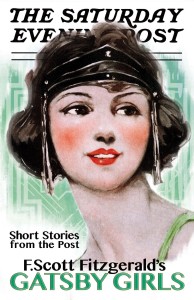
With all the hype surrounding the release of yet another Big Screen version of F. Scott Fitzgerald’sThe Great Gatsby, it’s no surprise that other works of Fitzgerald’s are being re-released. As a fan of the author, this thrills me no end. So when Gatsby Girls came in for review, I grabbed it, hunkered down in my favorite over-sized chair, and started reading. What a delight!
Gatsby Girls features eight short stories that Fitzgerald wrote in the 1920s for the Saturday Evening Post. These were the first of 68 stories of Fitzgerald’s that the Post published, and they all feature strong, carefree women. These characters were the inspiration for the “Flapper” – the romantic version of the 20s girl who has been popularized through the years in both movies and books.
The first story, “Head and Shoulders” (my favorite of the group), introduces the reader to Horace Tarbox, an intellectual young man busy with his studies. He meets, and falls in love with, Marcia Meadow, a singer at the local theater. This appears to be a simple story of ‘opposites attract’ featuring the studious Horace, and the free-wheeling actress Marcia. She dubs them “Head and Shoulders” for the odd pairing of one with brains and one with “shoulders” (a dancer who swings her shoulders). But as the story progresses, an unexpected twist sees that fate reversed. Another favorite (although I enjoyed them all) was “The Ice Palace.” In this tale, we meet Sally Carrol Happer, a young woman from Georgia. She’s bored with the quiet, dull life she has known and has decided to marry a northern man. When she travels north to meet his family, well, let’s just say winter is NOT the time for a Southern gal to travel north.
If you’re a fan of F. Scott Fitzgerald and have never read these stories – or even if you have – you’ll want to get a copy of this book. Along with the stories, the original illustrations from the Post are included as well as two appendixes, one that has reproduced all the stories as they first appeared in the Post, complete with ads, and again, with the illustrations. It’s worth the time just to enjoy the ads of the 1920s! The second appendix is of all the illustrations, enlarged a bit for easier viewing.
If you’ve never read any work of F. Scott Fitzgerald, what are you waiting for? The writing is exquisite, so descriptive and inviting. Impress your friends with knowledge of these stories – and I’m willing to bet you will discover a “new,” favorite author too.
At the front of the book is a brief biography that Fitzgerald wrote about himself for a weekly feature in the Post. This is followed by a brief history of the author’s time at the Post, including his salary (he went from $400/story to $4000/story!), critics’ opinions of the stories and his friends’ reactions, as well as a look at the popularity of his work. Before each story is a brief history of that tale, when it was published and a few other facts the reader will likely find interesting.
Quill says: Get ready for the “new” Great Gatsby by sinking into your favorite chair and getting lost in this “new” offering of short stories. They are a wonderful, enjoyable view into the world of 1920s Flappers and a country springing to life after a devastating war.
Sun-kissed Conspiracy!
 I look back on the nightmare that happened last year and wonder if it was all a dream. There are days when I still can’t believe that on that beautiful summer day, my wonderful, happy life with the man I loved—was turned upside down. Continue reading
Gatsby Girls Reviews

Available on AMAZON
“Francis Scott Key Fitzgerald (September 24, 1896 – December 21, 1940) was an American author of novels and short stories, whose works are the paradigm writings of the Jazz Age, a term he coined himself. He is widely regarded as one of the greatest American writers of the 20th century.
Fitzgerald is considered a member of the “Lost Generation” of the 1920s. He finished four novels: This Side of Paradise, The Beautiful and Damned, The Great Gatsby – his most famous – and Tender Is the Night. A fifth, unfinished novel, The Love of the Last Tycoon, was published posthumously. Fitzgerald also wrote many short stories that treat themes of youth and promise along with despair and age. Now eight of those short stories featuring Fitzgerald’s flapper ‘heroines’ drawn from the pages of the legendary magazine “The Saturday Evening Post” have been compiled into a 300 page anthology. In addition to these outstanding examples of Fitzgerald’s short stories, “F. Scott Fitzgerald’s Gatsby Girls” is enhanced for today’s readers with introductory information by Carol Monroe’s editorial notes, as well as two appendices: ‘Post-Pages’ and ‘Illustrators’ (featuring reproductions of original magazine illustration for these featured stories). A prized addition for academic and community library American Literature Studies collections, “F. Scott Fitzgerald’s Gatsby Girls” is very highly recommended reading and will well serve to introduce a new generation of readers to the literary talents of F. Scott Fitzgerald.”—Midwest Book Review
“ Loved reading about this new woman, sometimes brash ,contrary, as wiley and vindictive as a man, definitely learning to play the game. Sometimes it backfires, sometimes they are caught in the traditional versus the new values. All the women were interesting. Each was a little bit of Zelda as F. Scott sought to understand her.” -Joan E. Dugan, Amazon
“This book is such fun to read, especially for fans of F. Scott Fitzgerald. This book is a collection of the first 8 short stories Fitzgerald wrote for the Saturday Evening Post in 1920. Not only was this his first national exposure, these stories, and the artwork created by the Post, create the archetype of the ‘flapper’ that has become part of American culture. GATSBY GIRLS is beautifully formatted for digital devices, and includes the original pages of the Post, so you can see the stories in their original context… I loved reading these stories, and the seeming ease with which he creates these lovely characters and situations. Any Fitzgerald fan will really enjoy a chance to delve into these rare gems. Highly recommend!” -TwinsMomMM, Barnes & Noble
Fitzgerald, one of the foremost writers of American fiction, found early success as a short story writer for the most widely read magazine of the early 20th century — the Saturday Evening Post. Fitzgerald’s stories, first published by the Post between 1920 and 1922, brought the Jazz Age and the “flapper” to life and confirmed that America was changing faster than ever before. Women were bobbing their hair, drinking and flirting shamelessly, and Fitzgerald brought these exciting Gatsby Girls to life in the pages of the Post.”
My Two Cents:
Oh, how I sometimes yearn for days that I never actually had a chance to witness! “Gatsby Girls” had me yearning for one of those days. This book is a collection of F. Scott Fitzgerald’s short stories that appeared in the pages of the Saturday Evening Post. Imagine opening your newspaper and being able to read great short stories week after week. Now you’re lucky if your newspaper even has a book section! Oh, the good old days!
I hadn’t read any of Fitzgerald’s short stories so it was nice to get a chance to read them now! His stories are mostly about the flappers. As is mentioned in the note in the beginning of the book, Fitzgerald based many of his female characters on some aspect of his wife, Zelda Fitzgerald. I guess he truly wrote what he knew, eh? I’m absolutely fascinated by Zelda Fitzgerald so I found myself reading the stories with the idea that many of them were based on her in the back of my mind. Some of the stories I had heard of before but hadn’t read (such as Bernice Bobs Her Hair) and others I hadn’t heard of at all.
This is a great collection for those who have read Fitzgerald before or haven’t and are looking for a good jumping in point. I really liked that this collection included the pages of the Saturday Evening Post that the stories actually appeared on. Each story has really interesting illustrations and I also really liked being able to see what the pages of the post looked like (I got a kick out of some of the ads that were on the pages).
Overall, this is a great collection of stories!–A Bookish Affair Review
 “This collection of re-issued stories from the Saturday Evening Post is an instant favorite of mine. I really enjoyed the variety this collection offered. Each story is beautiful in its own way. I purchased the Kindle version, and I thought the illustrations were gorgeous.” -Lauren, Goodreads
“With the much-anticipated film of The Great Gatsby, starring Leonardo DiCaprio, about to smash the box office, what better time to turn your gimlet eye on the stories and the art that not only preceded it but offers literary and cultural context for the novel that is considered Fitzgerald’s most famous.” – Rebecca Rego Barry, Fine Books and Collections.com
“It’s a great addition to my Fitzgerald collection. Very informative, well researched with lots of extras.” – Donald Erman, OttowaSun.com
“F. Scott Fitzgerald was one of the greatest artists of the 20th century. His lyrical phrasing, his rich characters, and his unmistakable voice have placed him in the high echelon of American authors. Even though we only got to keep him until the young age of 44, he managed in that short time to give us iconic novels (The Great Gatsby, This Side of Paradise, Tender Is the Night, and more) and cranked out around 170 short stories.” – TopTenz.net
More Reviews and Quotes from the Past
. . . Many of the [short] stories are unequalled in achievement–inspirited with a delicate wit, a shrewd perception of character and a poetic sense of place–and lead us through Fitzgerald’s rich creative chronology, from unforgettable evocations of the enchanting but ruthless social whirl of the young in the 1920s.—Publishers Weekly (1989)
“One pleasure of rereading Fitzgerald’s stories now is to rediscover just how good some of them in fact are, and how brilliant a handful.” — Jay McInerney, The New York Review of Books
Fitzgerald was a better just plain writer than all of us put together. Just words writing.– John O’Hara to John Steinbeck, Selected Letters of John O’Hara (1978)
As all the high school juniors read The Great Gatsby, and anticipation mounts for Baz Luhrman’s 3D visual spectacle of Gatsby, it is an exciting development that The Saturday Evening Post has brought us this collection of little known short stories written by Fitzgerald in 1920. Among the first things he published, and certainly the biggest national platform he had til that point – these 8 short stories represent Fitzgerald at his most sparkling. I was, quite honestly, blown away by the glittering ease with which he conjured worlds. We all take it for granted now that the Flapper Girl of the ‘20s could flirt and kiss and bob her hair – what few realize is that these very stories CREATED the notion of that girl. The Post’s famed artists (including a Norman Rockwell cover that depicted a key scene from ‘Bernice Bobs Her Hair’) created the look that we now expect. As I read these stories, laid out beautifully for my tablet (thank you!), I could imagine the impact these would have had on countless girls and women, secretly reading the stories after Dad was done with the paper…and realizing that you could leave the farm, you too might have your pick of men, you could be daring and sophisticated…
This book is a delight – both for long-time fans of Fitzgerald (calling all you American Lit majors…) but also for those who aren’t. It is kind of a lovely thing – fun short stories by an acclaimed American author – that are just a joy to read!
Bonus – the book (esp great in color in the digital version) offers the original illustrations that accompanied the stories, and reproduces the actual pages of the Post in which the stories ran, so you can see the ads for farm equipment, men’s starched shirts and ladies shoes. – BandelierGirlReads.wordpress.com
The ICE PALACE
”Another Saturday Evening Post story, “The Ice Palace” was published in May of 1920 and was the first of what is called the “Tarleton Trilogy,” a trio of works set in Tarleton, Georgia. This story tells the tale of local belle Sally Carrol Happer and her harrowing visit to the cold North to visit her fiancé’s family. It is one of the most beautifully written of Fitzgerald’s short stories, and it contains autobiographical details from Fitzgerald’s own life, as he himself married a Southern Belle [Zelda].” – TopTenz.net
HEAD AND SHOULDERS
“Turn to this story for some of the wittiest banter of the 1920′s. . . .“Head and Shoulders” tells the story of an unlikely romance between Horace Tarbox, once child-genius now intellectual to the extreme, and Marcia Meadows, a dancer famous for her “shimmy.” The tables get turned when Horace takes a job as a gymnast to earn extra money while Marcia is pregnant, and she in turn writes a very clever and successful novel.” – TopTenz.net
THE OFFSHORE PIRATE
“The Offshore Pirate” is a fantasy story. Published in the Saturday Evening Post in 1920s, it tells the story of Ardita Farnan and how she falls in love with the “pirate” that overtakes her uncle’s boat on its way to Florida. Fitzgerald was especially fond of this story, especially the last line, which he said was one of his best. Fitzgerald was also quoted as saying that he liked this story better than “The Diamond as Big as the Ritz.” – TopTenz.net
The real Scott is to be found in his notebooks and working papers, where he elaborated so patiently at turning the mess of his life to gold. “To observe one must be unwary,” he wrote, so he took experience straight without a notebook. But he later hoarded it like a miser and pored over it like a monk illuminating a manuscript and produced enduring work. When a writer explores emotions to danger point like Scott, it is worse than philistine to talk about weakness of character. The whole moral test is in the books. The Great Gatsby and Tender Is the Night are all the character reference a writer could want. — Wilfrid Sheed, in “F. Scott Fitzgerald” (1973), from The Good Word & Other Words (1978)
“This is a valuable collection, whether one reads the stories to delight in Fitzgerald’s style, to conjure up a lost era, to learn more about the career of a great American novelist, or simply to gain insight into the human condition.” — Leonard A. Podis, The Cleveland Plain Dealer
With all the hype surrounding the release of yet another Big Screen version of F. Scott Fitzgerald’s The Great Gatsby, it’s no surprise that other works of Fitzgerald’s are being re-released. As a fan of the author, this thrills me no end. So when Gatsby Girls came in for review, I grabbed it, hunkered down in my favorite over-sized chair, and started reading. What a delight! Read the Rest of the Review from Feathered Quill Book Review