There’s no doubt about it, life as a teenager can be complicated. Growth spurts, body changes, voice quakes are all part of the norm—not to mention your ever-changing perception of yourself and how you “fit in” with your peers. Countless movies, television shows and books have been written about the struggles of the modern day teenager and it’s not always clear how to answer the question of “how do I survive???”
When Maya Van Wagenen was 14 years old, she dealt with pretty much the same challenges all young ladies of her age encounter. She wondered: How do I make friends? Why am I not popular? Why is it so hard to fit in at my middle school?
Her grandmother had been a social butterfly in Maya’s eyes. Constantly making new friends with the person in front of her at the grocery store line or with customer service representatives in India. So how come Maya was so shy and closed off with genetics like these? Surely it had to do with her looks right?
 One day while in her father’s office, she discovered a dusty old book from the 1950s entitled, Betty Cornell’s Teen-Age Popularity Guide. Amused, Maya began reading the book. She soon realized how little has changed in the last 60 years. Sure, it provided insight on everything from wearing white pearls and girdles to the proper ways to fix one’s “figure problems,” however the book still spouted some very relevant advice:
“Being pretty and attractive does help you to be popular, but being pretty and attractive does not and never can guarantee that you will be popular. There is another factor, a very important factor, and that is personality. Personality is that indescribable something that sets you off as a person. It is hard to explain but easy to recognize.”
“If you want to be a human being, and a popular human being, then you have to stop being an oyster and come out of your shell.”
Every month, Van Wagenen would take a chapter or two from the book and apply the suggestions to her own life. From dieting, hair and makeup to attitude to posture, she vowed to apply these tips, no matter how embarrassing or complicated they might be.
 Aside from her family, Van Wagenen didn’t tell anyone what she was up to. That would have taken the challenge out of it. It was through following Cornell’s vintage wisdom that Van Wagenen discovered herself and the inner self-confidence she needed to take on the scary halls of high school. By putting herself in sometimes painful, always hilarious situations, Van Wagenen learned that a little bit of old advice paired with a dash of bravery just might land you at the popular table.
When asked the most challenging part of the experiment, Van Wagenen told the National Post: “Skirts, girdles and pantyhose! . . .But really, the hardest part was putting myself out there and working on that internal change.”
She began chronicling her own experiences in high school using Cornell’s book as a reference. She learned to be a stellar hostess, practiced proper posture, and began styling her hair with rag curlers. She actively engaged in conversations with different social groups and took note of all of them.
 She began compiling pages and pages of her social experiment and before long, she had enough to write her own book. The recently published, Popular: Vintage Wisdom for a Modern Geek is a daring 272 page tale of honest, funny, and thought-provoking account of her efforts to become ‘popular’. She tells about her experiences of engaging with every social clique in high school over the course of a school year by constantly eating at new lunch tables. Jocks, band kids, slackers and nerds all got to know this young girl and she in turn got to know them. Maya realizes throughout her journey that everyone is the same inside and the reason some are more popular than others is that they simply take the time to listen, learn and engage with each other.
Can popularity advice from more than half a century ago still be relevant? I’ll find out. Crazier things have happened, right? Men have walked on the moon and society has found a way to grow square watermelons.
Betty Cornell has become my new soul mate, and I am married to her every word. For better or worse.—Maya Van Wagenen from Popular: Vintage Wisdom for a Modern Geek





 For more than two decades, Chester Nez kept silent about his role as one of the original Navajo code talkers responsible for developing an unbreakable code during World War II.







 By Katherine Sharma
 Katherine Sharma’s family roots are in Louisiana, Oklahoma and Texas. But after her early childhood in Texas, she has moved around the country and lived in seven other states, from Virginia to Hawaii. She currently resides in California with her husband and three children. She has also traveled extensively in Europe, Africa and Asia, and makes regular visits to family in India. After receiving her bachelor’s degree. in economics and her master’s degree in journalism from the University of Michigan, Katherine worked as a newspaper and magazine writer and editor for more than 15 years. She then shifted into management and marketing roles for firms in industries ranging from outdoor recreation to insurance to direct marketing. Although Katherine still works as a marketing consultant, she is now focused on creative writing.

 HBO’s Game of Thrones might be the most popular show on television right now. Great storytelling, incredible sets and wardrobe and just the right chemistry between the actors. But what if the casting had been slightly different? Would the show be the same if Kit Harington (Jon Snow) had been cast as King Joffrey (Jack Gleeson)? If Harington had his say, he would gladly give up the role of Snow to play the evil King.
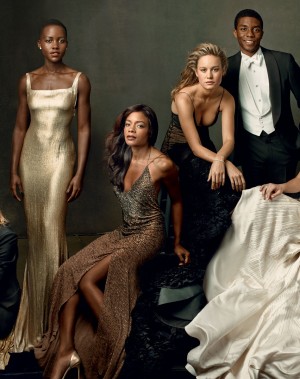 A recent issue of Vanity Fair featured some of Hollywood’s freshest young faces. Chiwetel Ejiofor (12 Years A Slave, American Gangster), Lupita Nyong’o (12 Years A Slave), Brie Larson (21 Jump Street) and the rest of the stars on the Hollywood Issue cover answer the question, “How did you feel the first time you saw yourself on film?”
 As the mysterious world of Orphan Black widens, new layers of the conspiracy are peeled back. Season one introduced Sarah, (Golden Globe® nominee Tatiana Maslany, Parks and Recreation) whose life changed dramatically after witnessing the suicide of a woman who looked just like her. Sarah learned that, not only were she and the woman clones, but there were others just like them, and dangerous factions at work set on capturing them all. She forged an alliance with fellow clones Alison Hendrix and Cosima Niehaus – and together they’ve been fighting for their freedom and the safety of their loved ones.
 Season two of BBC AMERICA’s dramatic conspiracy thriller, Orphan Black, hits the ground running with Sarah in a desperate race to find her missing daughter Kira (Skyler Wexler) – a wild pursuit that brings her head-to-head with ruthless pro-clone, Rachel (Maslany). This season also rejoins Sarah’s clone sisters Alison (Maslany) and Cosima (Maslany) as they struggle to keep their clone world a secret and pick up the pieces of their broken lives – all while dealing with the harsh reality that no one around them can be trusted.
 For a good discussion of the work, see the