



 By Katherine Sharma
In an upcoming book club meeting, we are discussing the short-story collection Runaway by Canadian Alice Munro, winner of the 2013 Nobel Prize in Literature as a “master of the contemporary short story.” Despite the prestigious award, Munro wasn’t an obvious choice. There is a hesitation in book groups to tackle a story collection; it’s hard enough to structure a conversation about one plot and set of characters, much less multiple ones! That’s a shame because some of our most iconic fiction is in short-story form. Consider the authors: Start with Chaucer and move on to O. Henry, Anton Chekhov, Edgar Allan Poe, Mark Twain, Jack London, Ernest Hemingway, Franz Kafka, Henry James, Guy de Maupassant, James Joyce, Flannery O’Connor, William Faulkner, Thomas Mann, Kurt Vonnegut, J.D. Salinger and Jorge Luis Borges, to name only a few. What about sci-fi giants Bradbury, Asimov and Clarke, icons of the eerie Stephen King and Shirley Jackson, or mystery masters Arthur Conan Doyle and Agatha Christie? There are hundreds of great writers of short-story gems. Some recent collections include Fragile Things by Neil Gaiman, Magic for Beginners by Kelly Link, Jhumpa Lahiri’s Interpreter of Maladies, and John Updike’s My Father’s Tears and Other Stories. As Publishers Weekly said of Munro’s Runaway stories of love, betrayal and time’s surprises: “One never knows quite where a Munro story will end, only that it will leave an incandescent trail of psychological insight.” But how to tap those insights in a single discussion? Short-story writers liken the process to appreciating an art gallery or rock album collection, meaning pieces appeal individually yet the collection is more than just the sum of its parts. Unique style and story-telling combine with recurring themes or characters to heighten the overall impact on readers. For book clubs who want to add a story collection to their roster, here’s a general plan of attack from one author, and for Runaway in particular, BookBrowse offers a discussion guide at http://www.bookbrowse.com/reading_guides/detail/index.cfm/book_number/1495/Runaway
ABOUT KATHERINE SHARMA
 Katherine Sharma’s family roots are in Louisiana, Oklahoma and Texas. But after her early childhood in Texas, she has moved around the country and lived in seven other states, from Virginia to Hawaii. She currently resides in California with her husband and three children. She has also traveled extensively in Europe, Africa and Asia, and makes regular visits to family in India. After receiving her bachelor’s degree. in economics and her master’s degree in journalism from the University of Michigan, Katherine worked as a newspaper and magazine writer and editor for more than 15 years. She then shifted into management and marketing roles for firms in industries ranging from outdoor recreation to insurance to direct marketing. Although Katherine still works as a marketing consultant, she is now focused on creative writing.
 The Woman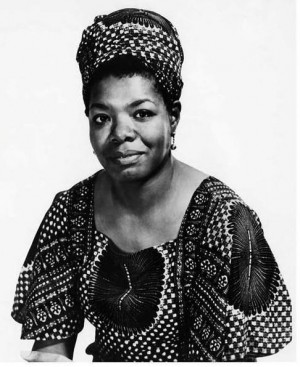

 HBO’s Game of Thrones might be the most popular show on television right now. Great storytelling, incredible sets and wardrobe and just the right chemistry between the actors. But what if the casting had been slightly different? Would the show be the same if Kit Harington (Jon Snow) had been cast as King Joffrey (Jack Gleeson)? If Harington had his say, he would gladly give up the role of Snow to play the evil King.
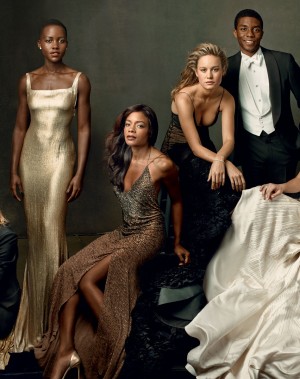 A recent issue of Vanity Fair featured some of Hollywood’s freshest young faces. Chiwetel Ejiofor (12 Years A Slave, American Gangster), Lupita Nyong’o (12 Years A Slave), Brie Larson (21 Jump Street) and the rest of the stars on the Hollywood Issue cover answer the question, “How did you feel the first time you saw yourself on film?”
 As the mysterious world of Orphan Black widens, new layers of the conspiracy are peeled back. Season one introduced Sarah, (Golden Globe® nominee Tatiana Maslany, Parks and Recreation) whose life changed dramatically after witnessing the suicide of a woman who looked just like her. Sarah learned that, not only were she and the woman clones, but there were others just like them, and dangerous factions at work set on capturing them all. She forged an alliance with fellow clones Alison Hendrix and Cosima Niehaus – and together they’ve been fighting for their freedom and the safety of their loved ones.
 Season two of BBC AMERICA’s dramatic conspiracy thriller, Orphan Black, hits the ground running with Sarah in a desperate race to find her missing daughter Kira (Skyler Wexler) – a wild pursuit that brings her head-to-head with ruthless pro-clone, Rachel (Maslany). This season also rejoins Sarah’s clone sisters Alison (Maslany) and Cosima (Maslany) as they struggle to keep their clone world a secret and pick up the pieces of their broken lives – all while dealing with the harsh reality that no one around them can be trusted.
 For a good discussion of the work, see the
  There’s no doubt about it, life as a teenager can be complicated. Growth spurts, body changes, voice quakes are all part of the norm—not to mention your ever-changing perception of yourself and how you “fit in” with your peers. Countless movies, television shows and books have been written about the struggles of the modern day teenager and it’s not always clear how to answer the question of “how do I survive???”
 One day while in her father’s office, she discovered a dusty old book from the 1950s entitled, Betty Cornell’s Teen-Age Popularity Guide. Amused, Maya began reading the book. She soon realized how little has changed in the last 60 years. Sure, it provided insight on everything from wearing white pearls and girdles to the proper ways to fix one’s “figure problems,” however the book still spouted some very relevant advice:
 Aside from her family, Van Wagenen didn’t tell anyone what she was up to. That would have taken the challenge out of it. It was through following Cornell’s vintage wisdom that Van Wagenen discovered herself and the inner self-confidence she needed to take on the scary halls of high school. By putting herself in sometimes painful, always hilarious situations, Van Wagenen learned that a little bit of old advice paired with a dash of bravery just might land you at the popular table.
 She began compiling pages and pages of her social experiment and before long, she had enough to write her own book. The recently published, Popular: Vintage Wisdom for a Modern Geek is a daring 272 page tale of honest, funny, and thought-provoking account of her efforts to become ‘popular’. She tells about her experiences of engaging with every social clique in high school over the course of a school year by constantly eating at new lunch tables. Jocks, band kids, slackers and nerds all got to know this young girl and she in turn got to know them. Maya realizes throughout her journey that everyone is the same inside and the reason some are more popular than others is that they simply take the time to listen, learn and engage with each other.
 What is the perfect place to find true love?
 Reviews