True Love Stories Award-Winning Story from March 1965:
 A woman’s amazing experience
It’s so easy for human beings to make a wrong decision, leading to grief for ourselves and sorrow for those who love us. Then often, when things seem darkest, we find the way to happiness has been open before us all the time—if we’d only had the faith and courage to see it. That’s how it was the day I learned I was to have a baby.
I’d suspected it, been panicky about it for some time, before I climbed the flight of stairs to Dr. McGee’s office and asked to be examined.
I didn’t know Dr. McGee . . . had picked him at random. “There’s no doubt about it, Mrs. Winters,” he said cheerfully. “You’re pregnant. From your condition and what you’ve told me, I would say the second month is well advanced. Have your husband come and see me as soon as he’s able. We can arrange for regular visits and proper treatment, and we’ll be having that baby before you know it.”
I left Dr. McGee’s, trembling. How happy I’d feel to be having Paul’s baby if things were different! But with Paul and me living the way we were—a long shudder ran through me, thinking of Paul.
What would this mean to him? To his plans for going back to college? It would upset them all! Or—would it?
I twisted the wedding ring on my finger—the ring I had no right to be wearing. All my evasions, my telling myself I was really Paul’s common-law wife, crumpled now in my need to face the bitter truth.
I had no claim on Paul or his future. Paul had made no commitments, no promises that would have to be broken. He
had merely taken me in when I’d had no other place to go.
He’d never said he wanted it to be a permanent arrangement.
Soberly, my thoughts went back to those months when Lola Newcome and I had shared an apartment in New York…back to that fateful party on my nineteenth birthday when Paul had bought me—for cash. It was at an auction that’d begun as a joke, but had led to our living together.
Now our baby was on its way—and he had no right to be.
I’d come to New York to become a dancer. Mother’d wanted to be one herself, and she’d transferred her ambitions to me. My father died when I was six. She’d scrimped from her small wages as a store clerk to give me dancing lessons and put a little aside for my future.
“You’ve real talent, Dotty,” she kept saying, though my teachers never did.
The same week I graduated from high school,’ Mother died of a heart attack. I settled up her small affairs, then headed toward New York with the money she’d put aside for that purpose. It wasn’t a lot, but it should see me through long enough to get launched on my career, I thought.
One of our neighbors gave me the name of her cousin, Lola Newcome, a bookkeeper in New York, and she, luckily, was looking for a new roommate. Our understanding was clear from the start. I met my share of the expenses and did my share of the work, or got out.
I went from one theatrical agent to another, walking the hard pavements of the city day after day, before I finally landed anything. It wasn’t much of an engagement, just a couple of weeks in a small night club across the river in Jersey City. But it was a start, and I was thrilled.
I liked living with Lola too. She was four years older than I, hard in some ways, but fun-loving and popular with both men and women. Her friends accepted me in their easy way.
Our apartment had a tiny bedroom and an even tinier kitchenette, but the living room was large enough for six or eight couples to get together for parties, which Lola had three or four times a week.
When I was working, I could only be at the Sunday night parties. But most of the time I was free, for the occasional
engagement I managed to find was usually for just a week or two at some small club. So I had plenty time for Lola’s parties.
They weren’t wild parties in any way. We would listen to the radio or records, drink a little, dance a little, or just talk. There was some smooching, and sometimes a boy got too familiar, but that was as far as it went. Lola was firm on that.
Not that she was straight-laced. We both knew, for instance, that Fred Vincent and Marilyn Blake, who came often to our parties, weren’t married but were living together. And Lola herself made no secret of the fact that she spent an occasional weekend at a Connecticut resort with her office manager.
“The main thing,” she told me once, in her sophisticated way, “is to be choosy about who it is, discreet, and then be careful!”
I’d been living at Lola’s for several months when I met Paul Winters at one of our parties. The boy I’d been dating couldn’t come, and someone brought Paul to fill in. We liked each other immediately, and after that he was invited as my date. I was glad, for we both still felt a little lonely among people who were friendly enough on the surface, but wanted nothing to do with your problems or troubles.
Paul was a quiet, nice-looking boy from a small town in Maine. He’d run out of money while studying engineering and was now working in a construction firm, saving toward going back to college later.
“I’ll be glad when it’s over,” he told me once. “I don’t like New York. It’s too big and too busy. When I get my degree I’d like to go to a small place where there’s my kind of people, then marry some nice girl like you and raise a family. But that’s years away. I don’t believe in obligations before you’re ready.”
I felt a warm sympathy for Paul, since I knew what it meant to have your eyes on a goal ahead.
Certainly, neither of us could have foreseen what took place at my birthday party. Lola’s birthday was in February. We’d had a party then and had so much fun, we decided to have one on my birthday, April twenty-fifth.
Soon after Lola’s party, I’d gotten what promised to be a real break, getting into the chorus of a new musical comedy. Elated, I’d gone out and bought a stunning dress for my birthday, on time. But after a week, I was let go, and this time being out of work was not only discouraging, but serious.
My share of the March expenses took most of my remaining funds. On the first of April, I could only give Lola part of my share. By then, I was desperate, and day by day, I could see Lola getting grimmer. I couldn’t blame her. It had happened to her before, and the other girl had never paid.
One day, after another fruitless hunt on my part, she said bluntly, “Why don’t you give up this dancing bug, and get a job where you can eat regularly? If you were really good, Dotty, you wouldn’t be having so much trouble!”
I looked at her, dumbstruck. I’d just had a run of bad luck, but my break would come! Mother’d known it, and so did I. “Just give me till the end of the month, Lola,” I begged.
By my birthday, I was really worried. To my surprise, Lola didn’t suggest calling off the party, and after it got going, I managed to cast off my gloom.
Maybe I drank a little too much, but Lola was drinking more than I and was still as grim as before. She sat with Belle Meredith. The two were talking earnestly—about me, I knew. I suspected that Belle would be glad to move in with Lola if I moved out. Then, as I was passing a plate of sandwiches, the general conversation turned to the fact that I wasn’t working again.
Belle looked up in her wide-eyed, baby-doll way to say, “But what are you going to do, Dotty? I mean, you can’t just go on sponging off Lola this way.”
Her bluntness nettled me, and I was angry with Lola for letting her think I’d been sponging. Still, I held my temper.
“Oh, I’ll do all right,” I said as airily as I could manage. “And I’m sure Lola is quite capable of looking after her own interests.”
Fred Vincent sensed the tension in our words and tried to divert us by joking. “What I do in a case like this,” he said, “is have an auction. Sometimes I sell everything, then use the money to start over, so I can buy it all back.” I could have kissed him when everyone laughed.
“That’s good advice,” I answered. “But what I own wouldn’t bring enough to pay off this dress. So all I have to offer is my own sweet self.”
“That’s fine, Miss Shaw!” Fred shot back. “Fancy packages bring fancy bids. It’s been done before too. Why, I got Marilyn by outbidding two other boys. Here—I’ll show you how.” He took the sandwiches and gave them to Marilyn. Then, taking my elbows, he lifted me onto a stool.
“There you are! Lola can be auctioneer, because she has first claim on the proceeds. Here, Lola—”
To my relief, Lola laughingly entered into the game. She held up my hand, looked around solemnly, and then began.
“All right—all right, ladies and gentlemen,” she chanted. “What am I offered for this luscious bit of femininity-ee? She walks. She talks. She dances and plays post office. In fact, she does everything! Now, what am I bid?”
Lola was really good, and everyone laughed when Fred bid ten dollars and was promptly pulled down by Marilyn.
“Ten dollars!” Lola scoffed. “Ten dollars wouldn’t pay for her bra and panties, much less the charms they conceal! Think, gentlemen—what it would mean to have these charms for your own—”
Quickly, there were bids from all sides. “Twenty dollars.” “Thirty.” “Fifty.” Sixty.” “Sixty-one!” When someone bid a hundred, Lola smiled at him.
“There! I’ll entertain that bid. A figure to justify the figure being auctioned. I’m bid a hundred! Do I hear more, or do I sell to the gentleman with the eye for figures? One hundred once—twi- ”
Paul had come up with his billfold in his hand. “My bid—” he counted hastily, grinning— “is a hundred and ten.”
“A hundred and ten is bid,” Lola intoned. “Do I hear others? A hundred and ten once—twice—and sold! A whole package of pulchritude for a hundred and ten dollars!” She scooped the bills from Paul’s hand and gave him my arm. “There you are, sir! You pays your money and you takes your purchase.”
She’d give the money back later, of course, and it had been loads of fun and everyone was laughing. . Someone proposed a toast for a last drink, and Paul sat with his arm about me while we drank. The party was breaking up, the others going by twos and threes into the bedroom for their wraps. Then everyone was gone but Paul. He mumbled something about “time to go,” and I went with him to the bedroom for his hat and coat.
Lola was clearing away, putting things in the sink. She came toward the bedroom, and I was sure she was coming to hand back Paul’s money. But she stopped at the door.
“Say, guy,” she said. “What’s your hurry to be off? Isn’t it unflattering to lack curiosity in what you’ve bought? It’s late, so you two can have the bedroom tonight. I’ll sleep on the sofa.” She closed the door.
I stood transfixed, Paul’s coat in my hands, realizing in panic that Lola had actually meant the auction and intended to keep the money!
Paul looked at me, his eyes questioning. “She sounds as if she meant that. Do you think she’s a little tight?”
“She does mean it—and she’s more than a little tight where money is concerned,” I said shakily.
“But she wouldn’t do that, Dotty,” Paul insisted. “Turn a joke into a—a thing like this. She couldn’t!”
“She has,” I choked. “She has your money and she intends to keep it for what I owe her. She feels it’s up to us from this point on.”
He was looking at me strangely. His voice was almost a whisper as he asked, “Dotty, you mean—you would?” Suddenly, all my tiredness and discouragement flowed through me like a burning ache. Weeks of tension, of fruitless going from agent to agent, overwhelmed me now. I felt a desperate need to lean on someone. And I did like Paul so much!
“Oh, Paul!” I sobbed. “I—I—”
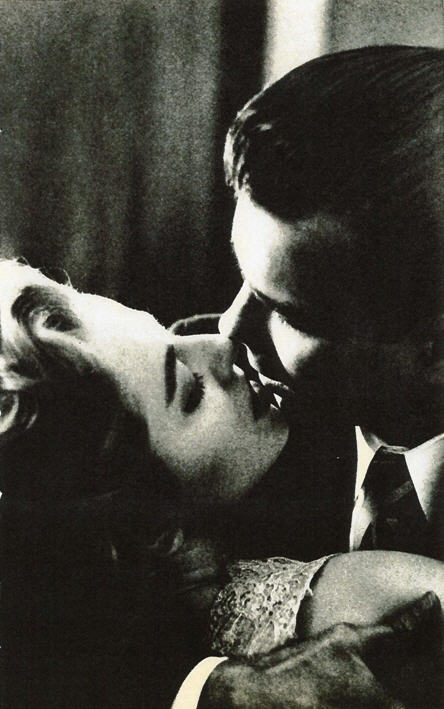 His arms were around me then, and he was kissing my lips, my eyes, my throat. What followed is still hazy in my mind. I had a sense of timeless unreality, a mixed feeling of being both ashamed of what I was doing and glad that I was doing it.
For Paul’s arms around me, the sweet intimate touch of his caress seemed to dissolve all my worries. . . .
The next morning, as we dressed, I avoided Paul’s eyes. By daylight things appeared differently, and nagging in my mind was the thought that on my nineteenth birthday, I had spent the night with a man—for money.
Sensing my shame, Paul drew me into his arms, where I mumbled shakily against his chest, “You don’t think I’m so nice now, do you?”
He took my chin; turned my eyes up to his. “Nicer than ever!” He said it almost fiercely. Of course, any decent man would say that. I tried to drop my eyes again, but he held them. “Don’t be sorry, kitten. Those things happen.”
But I couldn’t feel that way.
Lola wasn’t in the apartment. A note on the kitchen table said simply:
Dotty, sixty dollars is all you owe me.
You can give the rest back to the boy friend or pay your other bills with it. I’ll be gone all day, so don’t wait to say goodbye. L.
Paul read it, tight-lipped, then put the money in his pocket. “You can’t stay here,” he said. He hesitated, then said slowly, “Look, I know what it means to be broke. If—if it’s okay with you, you can stay with me till you get a break. You will, you know.”
I should have said no, but I had nowhere else to go. More than that, I needed somebody to show faith and interest in me this way.
A rush of tenderness for Paul surged through me. But all I said was, “It’s all right with me—with the understanding that what happens, or may happen, doesn’t bind either of us.”
I said that because I knew Paul’s plans for the future, and felt I should let him know I wouldn’t ever stand in his way. But there was a funny little ache in my heart as he gave me a long, appraising look and said, “Agreed!”
So I moved into Paul’s tiny apartment, and I bought a wedding ring, telling him, “So nobody’ll be suspicious.”
“Good idea,” he said, touching it. None of us likes to acknowledge ugly truths, so I’d finger the ring when I was alone, telling myself that I was really Paul’s common-law wife.
The summer was hot, the tiny apartment airless, but I liked taking care of it and of Paul. We spent most of our spare time on weekends at Coney Island, taking sandwiches with us and stretching luxuriously out on the beach. Evenings, we explored the city together, and I loved the feel of Paul’s arm around me, his dark eyes laughing into mine as he’d say, “It’s fun doing things together, Dotty!”
I still made the rounds of the theatrical agencies, driven both by ambition and because I felt Paul expected it, from the things he said. Like the time he paid my overdue bill at the dress shop.
“You shouldn’t have done it, Paul,” I told him. “But I’ll pay you back when I get my break!”
“Don’t worry about it, Dotty,” he said. “The important thing is to get that break. I want to see that you do.”
“But I owe you so much!” I protested.
“Forget it,” he told me. “You don’t really owe me anything. I’m saving more now than I did before. If the truth were known, I guess I’d owe you.”
Did he mean that it was unnecessary for him to spend money seeing other girls? It was an ugly thought and I rushed out of the room, my eyes brimming, then was sullen and quiet for the rest of the evening.
At breakfast, I was still depressed and silent. Paul behaved as if nothing had happened, but before leaving, he came around to my chair.
“Look, Dotty,” he said gently. “You’re worried sick over the wrong things. If you left here tomorrow, the only thing you’d owe me is a promise not to get mixed up with another iceberg like Lola.” He bent and kissed me, then left for work.
I thought of what Paul had said, and suddenly I knew why I felt so miserable. I was in love with Paul, utterly and completely. He was the only thing that mattered!
Face it, you ninny, I told myself. You don’t care about being a dancer; you don’t care about anything but being Paul’s wife! If you ever lose him, you’ll die, and men leave even wives they’re legally married to—and you’re only a common-law wife at best!
So at last, I faced part of the truth. From that minute on, I felt driven by a constant need to do more and more for Paul—to make myself so indispensable to him, he’d never let me go!
I cleaned the apartment like a demon, did all the laundry in the apartment washroom, shined his shoes and mended his socks.
Paul always gave me his pay check to cash at the supermarket. I’d tried to be careful before, but now I shopped so frugally that each week I put almost half his salary in the bank. That would be for his college.
I thought often of Lola and what she’d once said about doing too much for a man. “They get to think they own you, and start to treat you like a slavey instead of a lady. And who wants to be a slavey?”
Well, I was a slavey—and I loved it!
And Paul didn’t take advantage of it. Except for our physical intimacy, he was no different than when he’d dated me at Lola’s. Even there, he hadn’t been demanding. Now, he never acted as if our living together gave him the right. In fact, he was so tender and solicitous at times, that I could almost believe he was really in love with me.
Yet doubts crept in too—doubts any girl living with a man in anything but legal marriage can’t help having. Perhaps, with Paul, it was just a physical need that I could fill because of my youth and well-formed body. Perhaps he could never really love or respect a girl he’d won so cheaply. A girl he’d actually bought at auction!
I didn’t know the answer, and with Paul not too happy in his work and worried about losing so much time out of college, I didn’t dare raise more worrisome questions. I could only go on salving my pride with the thought that he let me use his name and wear a wedding ring—and that, surely, made me his common-law wife.
Despite my doubts, though, I took pride in my ability to please him physically, to feel him relax in my arms, free of tension and worry.
That’s how things stood that day late in July when Paul came home, bringing his kit with personal things with him from the office.
“What happened?” I asked uneasily. “Did you quit your job?”
“Yes,” he said briefly. “It was nip and tuck whether I quit or got laid off, so I thought I’d quit.” He took a restless turn about. “It’s too hot to talk here, Dotty. Let’s take some sandwiches down to the river. We can talk there.”
I found myself shaking with suspense as we settled down on the grass in Riverside Park. Paul looked up at me, hesitating a moment before he said, “Dotty, I have an offer from a brick firm in Pawtucket. Engineering. The kind I trained for and need to do.” He waited a moment, then added, “Pay’s good, too, and Pawtucket’s more my speed than New York.”
My heart was pounding so that I was sure he must hear it. Maybe this is it, I thought. Maybe this is where you lose him! I could hardly force myself to say, as casually as possible, “Do you think you’ll take it, Paul? When would you have to go?”
“I have to let them know within the week. I thought I’d talk it over with you.”
“With me, Paul?” My heart was smothering me now. “Why with me? It’s your future, and if it’s what you want—” I couldn’t force myself to go further.
“That’s true, I guess. But we are—well, together. I wondered if you’d want to go too—if you’d be happy away from here—where there’s always the chance to get that break you’re looking for.”
What was he trying to say? That he wanted me? That I wouldn’t be in the way? I had to know before I committed myself, but dear God, how I wanted to go! To be with him!
“I guess,” he went on, “you could stay here. I could leave you money—I’d want to know you were all right and I could come down some weekends—that is, if you didn’t mind. It’s up to you.”
My heart filled with relief. But my words were careful as I said, “If you want me to go, Paul, I want to go. And I don’t think I’ll lose any chances. It’s all pretty slow in the summer.”
He gave me a long, quiet look, then patted my hand, “Good! It’ll take a couple of days to get ready. You can pack our things while I scout around, pay bills and get the things we’ll need.”
The next day, when he came in, he deposited an armload of packages on the divan. Selecting one, he gave it to me. “Glamour for my kitten. You can model it for me later.”
He had this way, at special times, of bringing me gifts. A bra, panties, a pretty nightgown. I had grown to anticipate them, not for the gifts but for what followed. Always, after these “modelings,” Paul would pick me up in his arms, bearing me into the bedroom with an ardor I loved. This gift indicated clearly his pleasure that I was going with him to Rhode Island, and my heart sang with happiness.
Paul wouldn’t have asked me to go if he didn’t think of me as his wife, would he? Maybe he’d even told his new employers he was married. They asked such things, didn’t they? But Paul said nothing about this, and again, I was afraid to bring up the question.
We found a small, furnished cottage on a quiet street on the outskirts of Pawtucket. It felt good not to have to keep up the pretense of tramping around to agents when I didn’t care any more. But now…
I’ve heard a drowning person may review a whole lifetime in those last few moments before unconsciousness. I can well believe this, for all these things had run through my mind before I was halfway up the hill to our house, on the day Dr. McGee confirmed that I was going to have a baby. Each remaining block seemed a mile, each step to require an individual effort.
Somehow, I couldn’t kid myself any longer that I was a common-law wife. I was just a girl having a baby she had no right to be having, by a man who’d never made her any real promises. A man who wanted no permanent responsibilities.
What would Paul think now when I told him? What would he do? Suppose he said, “Well, Dotty, I guess this is where I get off. We’ll call it quits.”
I had an urge to run away, but where could I go? Back to New York? To take any kind of job now? Perhaps, but what of the time when I could no longer work, when I would need someone to help me and the baby? No, I couldn’t run away. I could only tell Paul and hope he’d stand by me.
For the rest of the day, I was like a zombie, moving in a nightmarish dream. I swept the floor, dusted, prepared Paul’s supper. All the time, my mind was turning over words, phrases, that I would use to tell him.
When he came home, he was full of what had happened at the plant that day “I guess I’m in, kitten! I was talking with Barton, the plant superintendent, today He says he needs someone for his assistant now that Lyons is leaving, and he thinks I’m it. If it works out, it’s a real break.”
As he went on, I knew I couldn’t tell him then. Couldn’t spoil his enthusiasm and bring new problems into his life at a time when he felt he was getting a real break.
I let another week pass, growing more and more scared. The doctor’d said regular visits and proper care. They must begin soon! Paul had finished his supper, the evening I decided, it must be tonight–now!
I looked across the table to where he sat with his book. How calm he looked. How serene and confident. Would he look that way after I’d told him? Well, I’d soon know.
“Paul. I—I—” Panic boiled up in my throat, stopping the words. Go on, tell him there’s going to be a baby, his baby, part of me cried. Tell him that after accepting his help, his home and protection, you’ve been caught, and now you really need his name for yourself and your child.. . .
The thought ended there. Paul had looked up. “Huh? Did you say something, kitten?” His very calmness added to my distraction, but I forced out more words in a tight, hoarse voice I didn’t recognize as my own.
“Y—yes. I’ve got to tell you something, Paul. I—I’m afraid—”
“Afraid of what?”
“I’m going to have a baby!” I blurted it out desperately.
Paul put down his hook and came around the table, his face incredulous. He put his hands on my shoulders and gave me a little shake. “A baby? Dotty, are you sure?” I nodded dumbly. “How long have you known?”
“A w-week,” I said as tears overcame me.
Paul looked at me for a long, searching moment, during which I died over and over.
“Why didn’t you tell me right away Dotty? Because you don’t want my baby? Because you couldn’t face that it might mean the end of your dancing career?”
“Oh no, Paul! I don’t care about being a dancer any more! I don’t care about anything but you!” I protested wildly, between choking sobs. “I was afraid of m-making t-trouble for you—of keeping you from g-going back to college and—”
His arm came around me then. “But I’m not going back,” he said. “Barton says I don’t need more technical training. It takes a certain knack to direct the efforts of trained personnel, and he thinks I have that knack.”
I stopped crying from sheer bewilderment. “Then, Paul—you—you mean you don’t mind? About the baby, that is?”
“Mind?” he held me tighter. “Why should I mind? Don’t you think I’d like to see our spare room turned into a nursery? Don’t you think I want—”
He stopped abruptly, and every ounce of blood oozed from my heart. He wanted kids, but not mine. Was that what he was suddenly realizing?
Then he ran my finger over my wedding ring. “Before we fix up that nursery, don’t you think we ought to make this official? Really get married, darling, I mean. When it was just the two of us, well–I knew it was a career, not me, you wanted. I understood. But we’ll both love the baby, and then—then maybe you can love me too.”
I looked at him unbelievingly. He’d always called me kitten or Dotty before. Now he was calling me darling—and as if he meant it! He’d asked me to marry him, and he was actually begging me to love him!
“Oh, Paul—” I clung to him, trembling. “I do love you! I’ve loved you for so long! But I couldn’t say it, for fear of losing you. I knew how much you wanted to finish college, to feel you had no ties. And—and you never said you loved me—” I choked on that.
“How could I?” he asked. “Maybe you’d have married me out of gratitude. But I didn’t want that. I wanted you to love me, if you could ever forgive me for taking advantage of you at a time when you were so desperate and confused. I wasn’t ready to think of marriage that night, Dotty. But I did love you, even then. Loved you and was weak enough to take advantage of your situation.
I’ve always felt, since then, that I cheated myself out of any chance of your really loving me in return. So I kept telling myself you wouldn’t care for my kind of life anyway. Then it wouldn’t hurt so much when I finally lost you.”
I never dreamed anything as small as my heart could hold so much happiness. I couldn’t have said another word myself, and I stopped Paul from saying more by pulling his lips down to mine.
The time’s coming close for my baby to be born, and every day I say a prayer of thankfulness that I’m not waiting for him in some shelter for unwed mothers. For when you cheapen love, have to lie and be afraid, it’s only pure luck when things work out, the way they did for me And even then, the heartbreak you go through leaves a scar that never quite heals.
Yes, our happiness—Paul’s and mine—will probably be shadowed for years by the memory of that shameful night, of the months we took our love without having the right to it. THE END




 Based on his best-selling memoir, the film tells the extraordinary and epic true story of Eric Lomax (played by one of our favorite leading men Colin Firth), a British Army officer who is tormented as a prisoner of war at a Japanese labor camp during World War II. Decades later, Lomax discovers that the Japanese interpreter he holds responsible for much of his treatment is still alive and sets out to confront him, and his haunting past. This story has been told several times before, and this latest retelling, from a screenplay by Frank Cottrell Boyce and Andy Paterson, wrestles with themes of suffering and redemption as it criss-crosses between Colin Firth’s aging Lomax living a purgatorial existence in late 20th-century Britain, and Jeremy Irvine’s embattled young soldier suffering at the hands of his wartime captors. Nicole Kidman co-stars as Lomax’s wife and love interest. The movie opens nationally on April 25, but you can watch the trailer now.
 The country’s #1 YouTube video is
 Mickey Rooney was born Joe Yule Jr. on September 23, 1920 in Brooklyn, New York and died in his Los Angeles home 93 years later. His passing marked the end of an incredible 80 year career in show business. Hands down, Rooney was the most popular and biggest box-office attraction in the final innocent prewar years of 1939, 1940 and 1941. Not because he was a dashing action hero lead or a glamorous romantic lead, but by playing a teenage boy, a character one contemporary critic called “the perfect composite of everybody’s kid brother.”

 Hungry for love, Joan fell for Bob when he began dating her. She soon realized he didn’t care in return and only desired her physically. In probing the psychological reason for Joan’s affair, it grew out of an unconscious desire to punish herself for hating her parents . . . and she continued the affair for the same reason, though she knew it could never lead to marriage. Therefore, reason A is correct. By putting herself in danger of becoming pregnant, Joan also wanted to prove to herself that perhaps her parents loved her a little. For if they would protect her at a time of such need, she’d know some measure of security.

 Katherine Sharma’s family roots are in Louisiana, Oklahoma and Texas. But after her early childhood in Texas, she has moved around the country and lived in seven other states, from Virginia to Hawaii. She currently resides in California with her husband and three children. She has also traveled extensively in Europe, Africa and Asia, and makes regular visits to family in India. After receiving her bachelor’s degree. in economics and her master’s degree in journalism from the University of Michigan, Katherine worked as a newspaper and magazine writer and editor for more than 15 years. She then shifted into management and marketing roles for firms in industries ranging from outdoor recreation to insurance to direct marketing. Although Katherine still works as a marketing consultant, she is now focused on creative writing.
 It will be interesting to see how the ratings and fans fare without Will Gardner and the sexual tension he brought to every scene with Alicia Florrick. The recent trend of killing off major characters in popular TV shows seems to be the new trend sweeping television. But the producers are confident that the backlash from fans won’t be too outrageous and that they will stick with the new storylines that have been created. Stay tuned!